Bishop’s Stortford lies beside the Roman Stane Street, which linked London with Colchester, and a ford across the river made the location an important stopping point for travellers and traders during Roman times. Later, a Saxon settlement grew around the river crossing.
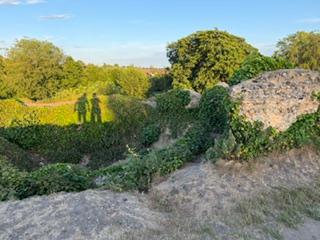
Just a short walk from the end of the navigation in Bishop’s Stortford are the remains of the 11th Century motte and bailey Waytemore Castle. The castle was built on earlier foundations, and Stone Age, Saxon and Roman remains were found in the area. Roman and medieval tiles are mixed in with the flint in the foundations now covered in ivy.
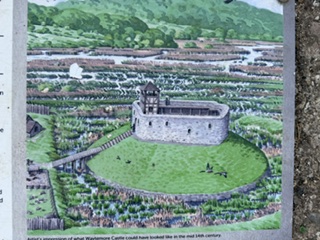
The castle was built after the Norman Conquest, but in 1211 the King ordered its destruction, only to have it rebuilt only a few years later. Looking at artists’ impressions, one can see water courses and streams as far as the eye can see.
Throughout the Middle Ages, Bishop’s Stortford held weekly markets. It was a good area for farming, and it’s convenient route between London, Colchester and Cambridge ensured plenty of travellers stayed overnight. Nowadays there are still plenty of old and lively inns in town
When the Stort’s navigation was improved in the 1700’s the whole area prospered. It made navigation to London and beyond possible, and, by the late 18th Century, the area was one of England’s leading supplier of malt to London Breweries.
With the arrival of the railway in 1842, the area prospered further. Not only did the railway improve transport of goods, but its vicinity to London soon made the towns along the Stort convenient commuter towns. Nowadays almost every village and town along the Stort has a railway station, with frequent trains going to Liverpool Street. Once the M11 was built, and then Stanstead Airport, Bishop Stortford reinvented itself. It is now a significant transport hub.
Unlike many market towns of similar age, with similar histories, many of the older buildings remain. The town centre is a pleasant shopping area with plenty of high street stores plying their trade from Victorian buildings, and there are several old pubs and plenty of green spaces.
For the boater, there is a basin at the end of the river, although sadly, too many boaters overstay their 14 days, and mooring can be hard to find. A little out of town, however, there are pleasant mooring spots and a good towpath, so don’t be put off. Like everywhere else, the majority of boaters are helpful and accommodating, and we found several along the last mile or so, giving us advice on where to moor and offering us the opportunity to raft up if we can’t find anywhere. We ended up on a 24-hour mooring at the end of the basin, underneath the current modern flower mill and had a peaceful night.


Leave a comment