It’s our intention to travel every side arm of every canal we’re on. Our motto is “they’ve built it for a reason, so let’s find out why”. So far we’ve achieved our goal by either going right to the end by boat, or going some way up the arm, then mooring and walking the rest, if the canal appears to be too shallow or silted up.
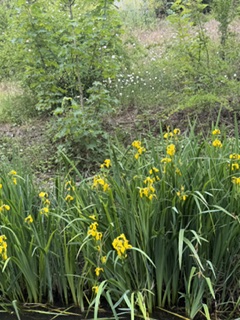
Slough had us defeated. We knew from asking around and reading up, that the 4-mile stretch is navigable, but plenty of people have advised us not to go to the end. The one that convinced us was from a guy working at the boatyard who said “you can try, but you’ll spend more time in the weed hatch than the tiller”.
There are two winding holes on the Slough arm, both large enough to wind a full-length boat, and both in good condition. The journey to the first one was pleasant and uneventful. The water irises were in full bloom and there were plenty of moorhen and coot chicks about, so we felt confident that we’d be able to get to the second winding hole without a problem. And we did.
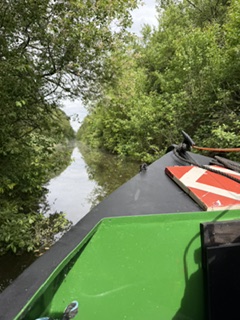
The canal is shielded from the canal-side industry by hedgerows, so once again we had the feeling of being out in the country despite being so close to factories and processing plants.
When we got to the second winding hole we were going to moor up and walk the last mile to the end. Unfortunately, there was a group of pretty unpleasant youths milling about, throwing abuse at us, so we didn’t chance it. We heard later from some boaters we met, that they did go down to the end, but it took them over eight hours for the two-mile stretch there and back, because they suffered continuous prop-wraps due to the weeds. I’m glad we aborted.
The interesting thing about the Slough arm is that it was built some 50 years after the railway was established in the town. It was the last canal to be built in that era.
Slough has extensive clay deposits, so the barges were used to transport bricks to London. It’s an easy, lock-free 8-hour route to Paddington Basin. On their return journey, the barges transported London’s waste to back-fill the clay pits. No doubt much of today’s industrial estates are built on land-fill sites.
It’s a shame that the approach to the canal basin is in such a poor state. I’m sure there is, like everywhere else in the country, a need for a canal-boat community. Slough, as a commuter town and with large industrial estates, surely has sufficient people who would cherish the opportunity to live close to town in a canal community.


Leave a comment