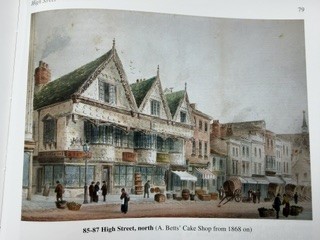
I love old towns, especially thriving old towns. Sadly, Banbury isn’t one of them – thriving I mean. Yes, there is industry, and yes, there is the historic boat yard and the new shopping centre and development along the canal. But the shopping centre is full of empty retail units and the canal-side development is all about chain-store restaurants.
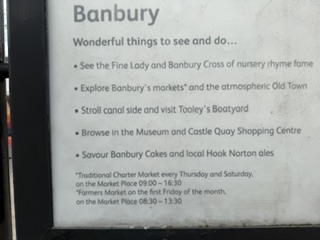
Despite everything I’ve said, I like Banbury. When you arrive by boat, you’re immediately steeped in history, and it’s lovely to walk down the lanes in the city centre, discovering ancient pubs and shops. For the boater, it has everything you could wish for. A fantastic boatyard, a supermarket close by, easy mooring and good train and bus services to just about anywhere in the UK.
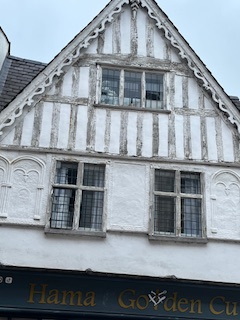
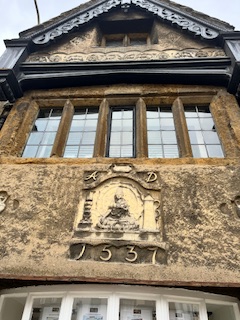
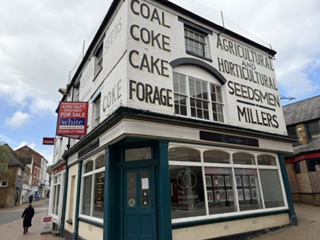
The town itself, made famous by the lady on a white horse riding to Banbury Cross, has a long history and an amazing array of beautiful old buildings. So why, oh why did the town planners not encourage retailers to utilise these wonderful spaces instead of creating yet another faceless shopping arcade?
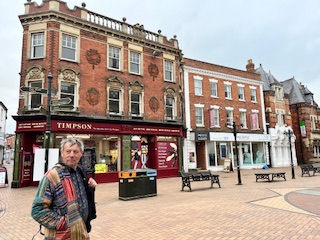
Let me introduce you to Banbury of the past.
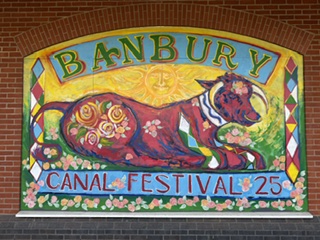
In the 1600s Banbury was a thriving market town. Sitting at the edge of the Cotswolds, it was made prosperous through trade in wool and livestock, but was also famous for cheese, cake and ale. Banbury had the largest cattle marked in Europe, where animals from as far away as Scotland were sold. The cattle market only closed in 1998.
In 1628 a fire destroyed about 1/3 of the medieval buildings and the civil war further added hardship to the town.
At the site of the modern shopping centre stood Banbury Castle, held by the royalists against the otherwise parliamentarian towns folk. Eventually the castle was besieged, the royalists fled and the castle was razed to the ground. Other than the name of the shopping centre, Castle Mill, there is now no sign of the castle. The stones from the castle were used for civil reconstruction, and many of the magnificent buildings we see today stem from that era.
In the 1700s Banbury once again became famous for a unique product – plush. Plush is a decadent fabric similar to velvet, which was used for upholstery, curtains and other household goods across the world. In its hay-day there were 179 weavers employed in villages around Banbury, who shipped their product across the world to noble households and embassies. The boom lasted for almost 200 years.
In Victorian times, improvements to roads, constructions of turnpikes and the building of the canal network meant that Banbury was a thriving, largely self-sufficient town, “overstocked in every department of business”. As well as the usual market town business, industry also provided employment in Banbury, most famously Alfred Bird – he of Birds custard, as well as iron works, and all manner of trade supporting the movement of goods on barges.
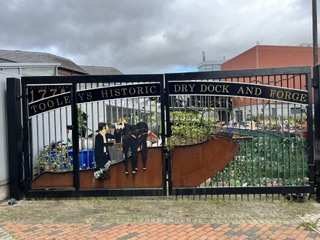
Tooleys boatyard opened its doors in 1778 and is still operating today. It is widely regarded as the oldest continuously working dry dock in the country. For 250 years, Tooleys has been a part of Banbury’s history – a place where boats are repaired, traditional canal skills are practiced, and heritage kept alive.
In the 20th Century, new industries attracted workers from London and other large cities, and later on large housing estates started to appear around the outskirts of Banbury, outside the original city walls.
It’s difficult to understand why nowadays Banbury feels like a desolate and sad place. It’s a lovely town with an ancient boatyard, beautiful buildings, a rich trading and industrial history, a canal running through it, has a museum and a theatre, restaurants, pubs, parks and outside spaces, and lots and lots of new housing development reaching far beyond the old town. It’s well worth a visit, but I would recommend wondering through the old town to find places to eat and drink. Don’t be tempted by the mediocre offer of the new canalside development. And do visit Tooleys. Folks are friendly and they have open days when their forge is in operation and the dry dock is used as an entertainment space. And do visit the museum, accessible via the shopping centre, where I gathered most of the historical information for this blog. It’s FREE!


Leave a comment